YATTLL Mobility Products Manufacturer Email: info@yattll.com

A trip to the shops or an afternoon with family should not depend on how far someone can comfortably walk. For older adults who need assistance over longer distances, a seated motorized mobility scooter can make more activities accessible.
However, the scooter also needs to fit everyday life. Can it go in the family car? Is it manageable to fold? Will the seat remain comfortable throughout an outing?
The right lightweight motorized scooter for an elderly user combines manageable transport weight, comfortable seating, accessible controls, and suitability for the intended route. A low number on a specification sheet is only one part of that decision.
This guide explains what to compare and introduces two models from the YATTLL mobility scooter range.
What Does “Lightweight” Actually Mean?
When comparing scooters, check exactly what the advertised weight includes.
A listing may describe the frame weight, the weight without the battery, or the complete assembled scooter. For a model that comes apart, the most useful figure may be the weight of its heaviest removable section.
Ask the supplier for three measurements:
- Complete operating weight: The scooter with the battery and necessary components fitted.
- Transport weight: The configuration you would actually lift into a vehicle.
- Heaviest component weight: Relevant when the scooter can be separated for transport.
These figures answer different questions. A scooter may be easy to drive but difficult for its owner or caregiver to load into a car.
Before purchasing, try the loading process with the person who will normally handle it. Consider the height of the boot opening, available grip points, and how far the scooter must be lifted.
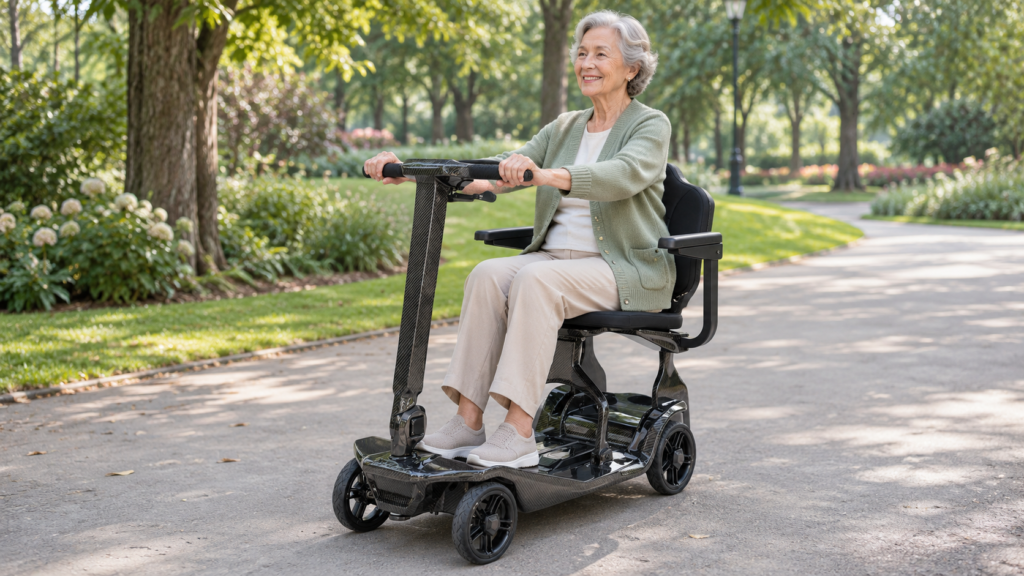
Why Folding Design Matters
A folding scooter can be useful when storage space is limited or car journeys are part of the weekly routine. But folding mechanisms vary, and a compact folded shape does not guarantee easy handling.
During a demonstration, check whether the user or helper can reach the release mechanism, complete the folding steps, and confirm that the frame is securely locked after unfolding.
Measure the actual vehicle opening as well as the space inside. A scooter may fit within the boot’s overall dimensions but still be awkward to pass through its opening.
For home storage, think beyond floor space. Plan where the scooter will be charged and whether it can be moved there without blocking a doorway or regularly used route.
Comfort and Control Should Guide the Choice
An elderly rider may spend a substantial part of an outing seated on the scooter. Seat dimensions, foot space, and control position deserve a practical trial.
Check whether the rider can:
- Sit comfortably with their feet supported.
- Reach the tiller without leaning forward excessively.
- Turn the handlebars through the required range.
- Read the display and identify the controls.
- Get on and off using the procedure described in the manual.
A wider seat is not automatically a better fit. The rider should be able to maintain a comfortable position while still reaching the controls.
Use a demonstration to practise starting, stopping, reversing, and turning at a low setting. If the rider struggles with these tasks, seek an individual equipment assessment before deciding.
Match the Scooter to the Route
Start with the places the scooter will actually be used: a supermarket, a paved neighbourhood route, a retirement community, or a family holiday destination.
Then check the manufacturer’s limits for gradients, surface conditions, and obstacles. Do not assume a portable scooter is designed for gravel, rough paths, or steep slopes.
For indoor use, measure narrow entrances and consider the space available to turn. For outdoor trips, ask the supplier how the model should be used around uneven paving and changes in level.
Wheel count, frame material, or motor power alone cannot establish whether a scooter is suitable for a particular route. Review the operating instructions alongside the specifications.
Battery Range: Plan Around the Whole Journey
Battery range should cover the complete outing, including the return trip and a practical reserve.
Ask how the advertised range was measured and what conditions affect it. Avoid planning a journey that depends on reaching the maximum stated distance.
Charging arrangements also matter. Confirm where charging is permitted, which charger is supplied, and whether the battery can be removed if separate charging is needed. Follow the model’s charging and storage instructions.
For occasional users, request guidance on maintaining the battery between trips. A scooter that spends several weeks in storage still needs an appropriate battery-care routine.
YATTLL Lightweight Mobility Scooters to Compare
YATTLL lists carbon fiber scooters with different weight and seating specifications. The following comparison uses the figures currently published on the respective product pages.
| Specification | YATTLL YECZ2 | YATTLL YECZ4A |
|---|---|---|
| Frame material | Carbon fiber | Carbon fiber |
| Listed net weight | 11 kg | 14 kg |
| Listed maximum load | 125 kg | 180 kg |
| Maximum speed | 6 km/h | 6 km/h |
| Motor power | 180W | 200W |
| Published seating detail | Confirm current seat dimensions | 468 mm seat width |
| Published transport detail | Folded dimensions: 100 × 44.5 × 32 cm | Confirm current folded dimensions |
Specifications are from the YECZ2 product page and YECZ4A product page. Confirm the supplied configuration and the components included in each weight figure before ordering.
The YECZ2 is worth discussing when a lower listed weight and documented folded dimensions are priorities. The YECZ4A offers a higher published load capacity and specifies width-adjustable armrests.
Neither specification set determines suitability on its own. Compare both models against the rider’s seating needs, transport arrangements, and intended routes.
Questions to Ask Before Ordering
A short conversation with the supplier can resolve details that are easy to miss online:
- Does the quoted weight include the battery, seat, and armrests?
- Can we see the complete folding and loading process?
- What are the permitted gradients and surface conditions?
- Which components require routine inspection or servicing?
- Where can replacement batteries, tyres, and other parts be obtained?
- What does the warranty cover, and who handles service locally?
For further model information, review the YATTLL product catalogs and technical brochures.
Frequently Asked Questions
Can an elderly person lift a lightweight scooter independently?
Possibly, but the scooter’s weight alone cannot answer that question. Strength, balance, grip, lifting height, and the shape of the folded scooter all matter. Arrange a practical demonstration using the intended vehicle.
Does a lightweight scooter have a low weight capacity?
Not necessarily. Scooter weight and rated load capacity are separate specifications. Compare the manufacturer’s stated capacity for each model and clarify how carried items count toward that limit.
Can a folding scooter be taken on an airplane?
Confirm acceptance with the airline before booking. Ask the supplier for battery specifications and handling information to provide to the carrier. A folding design alone does not establish airline acceptance.
What should matter most when choosing a scooter for an older adult?
Begin with comfortable seating, manageable controls, and suitability for the rider’s usual journeys. Then confirm that storage, charging, transport, and servicing are practical for the household.
Explore Lightweight Mobility Options with YATTLL
YATTLL supplies mobility scooters for distributors, medical equipment suppliers, and mobility businesses, with wholesale and OEM/ODM options available.
For current specifications, model comparisons, or supply enquiries, contact the YATTLL team with the intended rider requirements, transport needs, and market information. These details help narrow the choice to a scooter that fits everyday use.